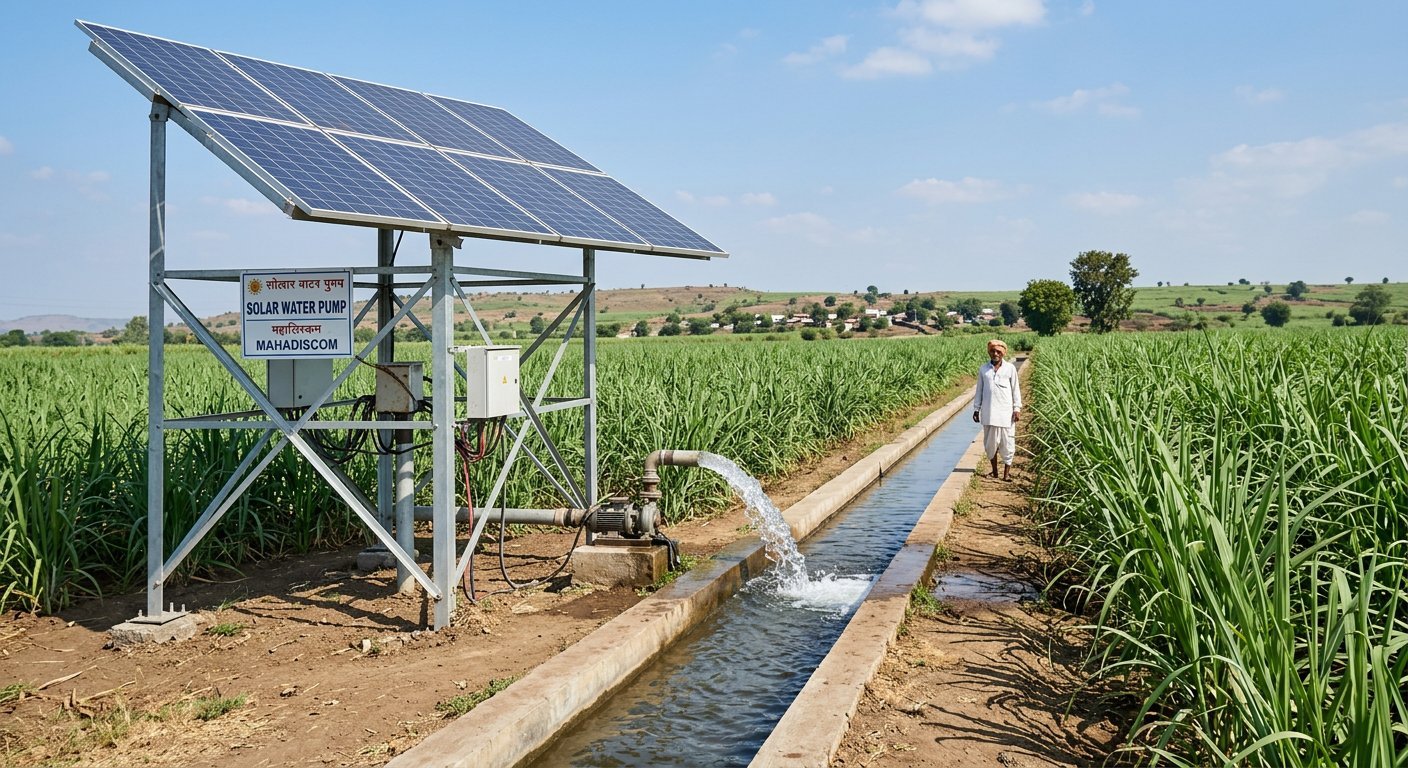
The most common mistake in solar pump purchases is buying on HP alone. A 5 HP pump at 80 m head delivers far less water than the same pump at 20 m. Sizing must start with your water, not the nameplate.
Three numbers decide everything
- Total head — water depth plus vertical lift plus friction losses in the pipe. Add roughly 10% for every 100 m of pipe run.
- Daily water requirement — in litres, based on crop, area and irrigation method. Drip needs 30–50% less water than flood.
- Solar window — usable sunlight hours in your location (typically 5.5–6.5 hours in Maharashtra).
Indicative sizing chart
| Pump | Array | Head range | Daily output | Typical area |
|---|---|---|---|---|
| 1 HP | 1.5 kW | Up to 15 m | 25,000–35,000 L | Kitchen garden, tank filling |
| 3 HP | 3 kW | 15–60 m | 60,000–90,000 L | 3–5 acres drip |
| 5 HP | 4.5–5 kW | 40–80 m | 1,00,000–1,40,000 L | 5–8 acres |
| 7.5 HP | 7.5 kW | 60–100 m | 1,60,000–2,20,000 L | 8–12 acres / FPO |
DC or AC pump?
DC submersible pumps are efficient and go deeper without a drive, but replacements and repairs are less locally available. AC pumps with a VFD solar drive are more serviceable in Maharashtra and allow grid changeover for monsoon days — usually the better choice for farms that already have a connection.
What PM-KUSUM covers
Component B (standalone pumps) and Component C (solarisation of existing grid-connected pumps) are the relevant schemes for most farmers. Assistance is shared between centre and state, and the exact percentage depends on the component, land category and the implementing agency for your district.
Before you pay an advance
- Ask what head the quotation was sized for — if the vendor cannot answer, they guessed.
- Confirm whether the array includes a tilt structure and lightning protection.
- Check the pump controller has dry-run and overload protection; borewells run dry in May.
- Ask who prepares the subsidy file and what happens if it is rejected.
We survey the borewell, measure the head and size the array before quoting — which is why our pump customers see the promised water output rather than a system that disappoints in the first summer.
Solar engineer at EcoHarbor Solar Share on WhatsApp
Need a quotation?
Our engineers will size a system for your exact roof and send a written proposal with subsidy and payback.
Book free surveyEstimate your savings
Use our calculator to see recommended kW, subsidy, net cost and 25-year savings in 10 seconds.
Open calculator